



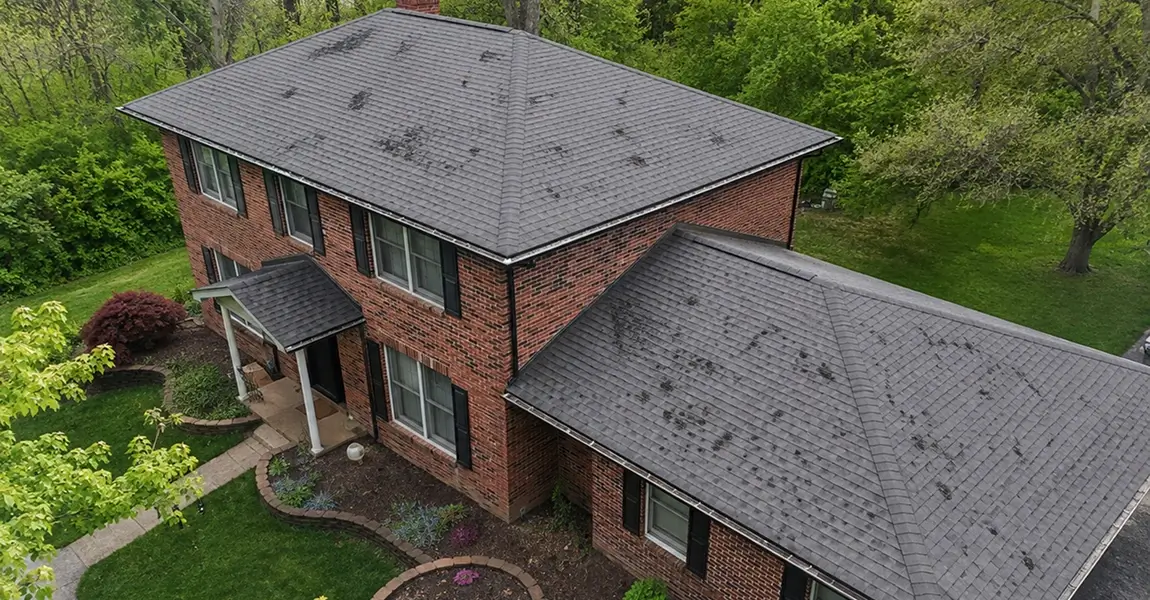
Hail damage in St. Louis County affects thousands of homes every summer, and the decisions made in the first 48 hours after a storm determine how well a homeowner navigates what comes next. North St. Louis County communities including Hazelwood, Florissant, Ferguson, Bridgeton, and Maryland Heights sit in a storm corridor that sees multiple significant hail events between May and July each year. One Way Roofing responds to hail damage calls across St. Louis County after every major event. This guide walks you through exactly what to do, what to avoid, and what your rights are throughout the entire process.
The Quick Answer: What Should You Do After Hail Damage in St. Louis County?
After hail damage in St. Louis County, stay off your roof and document everything from the ground using time-stamped photographs within the first 48 hours. Check gutters, downspouts, window screens, and your AC condenser unit for visible hail impact evidence. Inspect your attic for fresh moisture or daylight through the deck boards. Then contact a verified local roofing contractor for a professional inspection before you call your insurance company. Do not sign any contract from an unsolicited door-to-door contractor. The decision you are making involves thousands of dollars and deserves time and independent verification.
What North St. Louis County Homeowners Usually Notice First
After a significant hail storm rolls through St. Louis County, the yard gives the first evidence before anyone looks at the roof. Hailstones on flat surfaces, dented aluminum gutters, split window screens, and dimpled AC condenser fins confirm what arrived at your property and at what intensity level. These exterior indicators do not prove hail damage in St. Louis County exists on your specific roof, but they confirm the event was forceful enough that a professional inspection is warranted.
Most Hazelwood and Florissant homeowners walk the yard, see no shingles in the grass, and conclude the roof made it through intact. This assumption is one of the most consistently costly mistakes One Way Roofing encounters across North St. Louis County after every significant storm season. Hail damage on shingles Missouri inspectors look for is rarely visible from ground level. The impact bruise, the granule displacement, the cracked pipe boot, the lifted ridge cap. These are rooftop details that require trained eyes and safe roof access, not a ground-level walk around the yard.
Why Hail Damage in St. Louis County Is Especially Frequent in North County
North St. Louis County sits in a secondary storm corridor that channels weather systems moving northeast across the Missouri and Mississippi River valleys. According to NOAA storm event data for the St. Louis metro area, St. Louis County experiences between 4 and 7 significant hail events per year during the peak May through July window. Hazelwood, Florissant, Bridgeton, and Ferguson sit in the direct path of systems that frequently intensify as they cross the Missouri River before reaching the North County corridor.
Homes built in North St. Louis County between 1960 and 1990 were constructed with roofing materials and installation standards that did not anticipate the cumulative storm exposure these neighborhoods have now experienced across multiple decades. A roof replaced in 2008 on a Hazelwood split-level has absorbed more than 15 years of North County storm seasons. Hail damage in St. Louis County accumulates across multiple events, and a roof that has never been professionally inspected after storms has typically absorbed years of functional degradation before any visible failure occurs.
The 48-Hour Hail Damage Action Plan for St. Louis County Homeowners
Hours 1 to 4: Ground-level documentation.
Do not climb the roof while it is wet or while storms remain in the area. Work from the ground first and document with your phone’s time stamp enabled. Photograph hailstones on flat surfaces including the deck, driveway, and vehicle hood before they melt. Photograph dented gutters and downspout elbows. Photograph cracked window screens. Photograph your AC condenser unit fins, which are one of the most reliable soft-metal impact indicators available without going on the roof.
If hail was large enough to dent soft aluminum gutters, it was large enough to cause functional hail damage in St. Louis County on standard architectural asphalt shingles. One Way Roofing uses this soft-metal benchmark on every post-storm inspection across St. Louis County as a starting indicator of storm intensity.
Hours 4 to 8: Attic inspection.
Take a flashlight into your attic before the end of the first day. Look for fresh water staining on the underside of decking boards, wet or compressed insulation, daylight visible between deck boards, and rust rings around fastener points. Fresh attic moisture after a hail storm St. Louis County event tells you the storm found an entry point at an existing or new weakness. Photograph every finding with the time stamp enabled.
Hours 8 to 24: Gutter examination.
After the first rain following the hail event, or by examining directly, check every gutter section for granule accumulation. Dark, sand-like particles at gutter floors and downspout exits after hail damage in St. Louis County are direct physical evidence that hail impact displaced protective granules from shingle surfaces. One Way Roofing photographs and documents gutter granule accumulation as part of every post-storm roof inspection St. Louis County written damage report.
Hours 24 to 48: Professional inspection.
Contact a verified local roofing contractor with a documented presence in St. Louis County. One Way Roofing provides free post-storm inspections across Hazelwood, Florissant, Ferguson, Bridgeton, Maryland Heights, Creve Coeur, Webster Groves, Fenton, and surrounding St. Louis County communities. A professional inspection covers the full roof surface with documented impact pattern mapping, granule loss assessment by slope, ridge cap and hip condition evaluation, flashing assessment at all penetrations, and a written scope of loss with labeled photographs. This written report is what you bring into any conversation with your insurance company.
What One Way Roofing Looks for on a Hail Damage Inspection in St. Louis County
On many post-storm inspections across North St. Louis County, the documentation pattern that distinguishes genuine functional hail damage in St. Louis County from normal aging follows specific characteristics One Way Roofing is trained to identify, distinguish, and report accurately.
- Impact pattern consistency. A genuine hail event produces a directionally consistent pattern of impacts across all exposed roof surfaces, oriented in alignment with the storm track direction. Random scattered impacts or impacts isolated to a single section without directional explanation are inconsistent with hail damage roof St. Louis County documentation standards. One Way Roofing maps impact density per roofing square and assesses whether the distribution meets the pattern recognized in St. Louis County claim processes.
- Granule bruising versus normal aging loss. The defining characteristic of hail damage on an asphalt shingle is a circular area of concentrated granule loss where impact force displaced granules from the asphalt mat in a defined pattern. One Way Roofing distinguishes genuine hail bruising from normal aging granule loss using the freshness of the exposed mat color, the defined edge boundary of the impact zone, and the consistency of the pattern across the full slope.
- Soft metal corroboration. Hail that creates functional damage to asphalt shingles also leaves measurable dents in soft metal surfaces including aluminum valley flashings, lead pipe boots, copper step flashing, and AC condenser fins. One Way Roofing photographs and includes soft metal impact documentation in every written scope as corroborating evidence of storm intensity.
- Functional damage versus cosmetic change. Not every visible impact constitutes functional damage in the insurance and repair context. One Way Roofing clearly distinguishes between impacts that meaningfully reduce a roof’s remaining serviceable life and surface changes that affect appearance without affecting performance. Our written scopes reflect this distinction accurately, which is why they carry credibility in adjuster re-inspection conversations.
What One Way Roofing Can and Cannot Do in Your Hail Damage Claim
Missouri homeowners deserve complete transparency about where a roofing contractor’s role begins and ends when an insurance claim is involved, and One Way Roofing communicates this directly.
- What One Way Roofing can do. Inspect your roof and provide a detailed written scope of loss at no charge. Document all hail damage in St. Louis County on your property with labeled photographs and precise measurements. Be present during your insurance adjuster’s inspection or re-inspection with our written documentation in hand. Prepare and submit supplemental scope documentation when additional damage found during work was not captured in the original adjuster scope. You can learn more about how we support homeowners through this process on our insurance claims page.
- What One Way Roofing cannot do. File your claim as your representative. Negotiate a settlement with your insurer on your behalf. Sign claim paperwork in your name. These functions require a Missouri public adjuster license under RSMo 375.141. One Way Roofing does not hold a public adjuster license. Your claim remains between you and your insurer throughout the entire process.
- What One Way Roofing will never do. Offer to waive, absorb, or work around your insurance deductible in any form. This is explicitly illegal under Missouri RSMo 375.1010 and constitutes insurance fraud by both the contractor and any homeowner who accepts the arrangement. Any contractor making this offer in connection with hail damage repair across St. Louis County is identifying their operating ethics before a single shingle is touched.
Common Mistakes St. Louis County Homeowners Make After Hail Damage
- Waiting too long to document. Subsequent rain events wash granule evidence from gutters and redistribute physical hail damage indicators. The physical contrast between fresh hail bruising and surrounding shingle surface becomes progressively harder to document distinctly as days pass. One Way Roofing treats the 48-hour window as a firm deadline for initial documentation, not a general suggestion.
- Calling insurance before getting an independent inspection. Entering the adjuster conversation without an independent contractor scope puts the homeowner at a significant information disadvantage. When you have a written damage report from a verified St. Louis County roofing contractor before the adjuster visits, you have a documented baseline against which the adjuster’s scope can be measured and compared.
- Signing a contract the same day an unsolicited contractor visits. Missouri’s Home Solicitation Sales Act under RSMo 407.700 gives every homeowner 3 business days to cancel any contract over $25 signed at their home. Use that window fully.
- Accepting the first insurance settlement without comparing it to a contractor scope. On many post-settlement conversations with St. Louis County homeowners, One Way Roofing finds missing line items in adjuster scopes that represent real costs including drip edge replacement, ice and water shield in valley areas, and permit fees.
A Real Scenario: A Florissant Homeowner After a July Hail Event
A Florissant homeowner contacted One Way Roofing four days after a significant July hail event that produced documented golf-ball-sized hail across multiple North St. Louis County zip codes. The homeowner had photographed their gutters and yard immediately after the storm and had not yet contacted their insurance company or signed anything with any contractor.
One Way Roofing inspected the roof within 24 hours of the call. The inspection documented a consistent directional impact pattern across the north and west slopes, significant granule displacement bruising consistent with the documented storm event, denting on all soft metal surfaces including pipe boots, valley flashings, and AC condenser fins, and two areas of lifted ridge cap creating an active moisture entry risk.
One Way Roofing provided a written scope of loss with labeled photographs within 48 hours of the inspection. The homeowner submitted that scope to their insurer and requested a re-inspection with our documentation present. The revised settlement addressed all documented line items including items absent from the initial adjuster scope. One Way Roofing did not negotiate this claim. The homeowner used the policy rights available to them with accurate, specific documentation in hand.
One Way Roofing serves homeowners across St. Louis County including Hazelwood, Florissant, Ferguson, Bridgeton, Maryland Heights, Creve Coeur, Webster Groves, Fenton, and Richmond Heights. Visit our Facebook page
If your St. Louis County home was hit by hail, the next 48 hours are your most important window. One Way Roofing provides free post-storm inspections with written damage documentation across the full St. Louis County service area. Contact us before the evidence window closes.
Schedule Your Free Hail Damage Inspection
Frequently Asked Questions
How do I know if hail damage in St. Louis County on my roof is serious enough to file a claim?
This is best determined after a professional inspection with a written scope rather than before. One Way Roofing provides free post-storm inspections across St. Louis County. If functional damage covers more than 25 percent of your roof surface and your roof is over 10 years old, a claim conversation is worth having. If the damage is minor and your deductible is close to the repair cost, paying out of pocket may be the smarter financial decision.
Should I call my insurance company or a roofing contractor first after hail?
Call a verified local roofing contractor first. A written damage report from an established St. Louis County roofing company before the adjuster visits gives you a documented baseline. If the adjuster scope is lower than the contractor assessment, you have specific written evidence to support a formal re-inspection request.
What if my insurance company says the damage is from wear and tear rather than hail?
This is one of the most common denial grounds in hail damage insurance claim St. Louis County situations. One Way Roofing documents the impact pattern, soft metal corroboration, and specific characteristics that distinguish hail bruising from normal aging granule loss. Submit the contractor documentation in writing and request a formal re-inspection. You can also file a complaint with the Missouri Department of Insurance at insurance.mo.gov if you believe the denial is improper.
Can a roofing contractor negotiate my hail damage claim in St. Louis County?
No, not without a Missouri public adjuster license under RSMo 375.141. One Way Roofing provides detailed written documentation and is present at adjuster re-inspections, but the negotiation and settlement of your claim is between you and your insurer.
How long do I have to file a hail damage claim in St. Louis County?
Your specific insurance policy controls this deadline. Most policies require filing within one year of the date of loss, but some require as little as six months. Read your policy Duties After Loss section before assuming you have unlimited time. One Way Roofing recommends acting within the first 30 days of a significant hail event to preserve the strongest possible evidence record.