



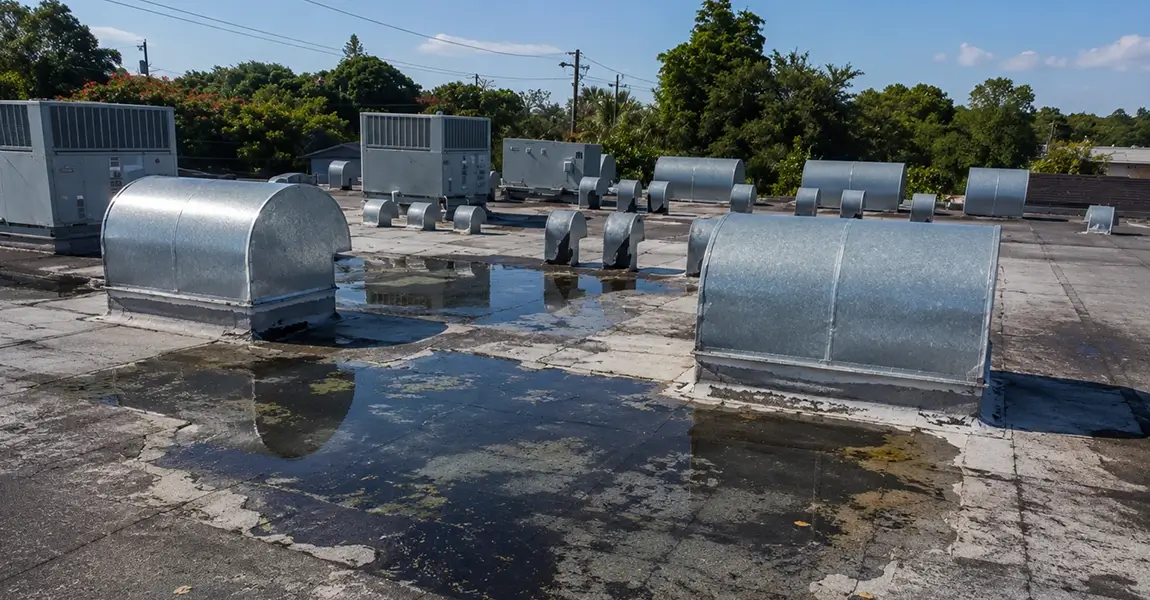
A commercial roof inspection in Fenton is the single most cost-effective maintenance decision of a property manager in St. Louis County’s south corridor can make and the one most consistently deferred. Fenton’s commercial and industrial strip along the Meramec River corridor carries a significant concentration of flat and low-slope roofs, many of them aging into their second decade. Across this market, One Way Roofing responds to commercial roofing Fenton calls where the warning signs were visible 6 to 18 months before the ceiling tile came down or the tenant filed a complaint. This checklist tells you exactly what those signs are and what each one means for your building.
The Quick Answer: What Signs Demand a Commercial Roof Inspection in Fenton?
The seven signs that most reliably precede commercial roof failures in Fenton and the surrounding St. Louis County commercial market are ponding water that stands more than 48 hours after rain, visible membrane blistering, open or separated seams, cracked or lifted flashing at penetrations, soft or spongy sections underfoot when walking the roof surface, interior ceiling staining or persistent musty odor, and blocked or misaligned drainage fixtures. Any single one of these is a reason to schedule a commercial roof inspection Missouri property managers can act on immediately. Finding more than one together is a reason to act this week.
Why Fenton Property Managers Defer Commercial Roof Inspections Longer Than They Should
The business case for deferral feels rational at the moment. No active leak has been reported. No tenant has called. Budget cycles are tight and a commercial roof inspection in Fenton feels like a discretionary spend until it becomes a crisis spend.
On many commercial roofing Fenton inspection calls, One Way Roofing arrives to a situation where the financial math has already inverted against the property owner. A seam failure identified and repaired during a spring flat roof inspection Fenton MO appointment is a $600 to $1,500 repair. That same seam failure, left unaddressed through Missouri’s summer storm season, produces saturated insulation, interior water entry, and in occupied commercial spaces, potential mold growth requiring third-party remediation. That project starts at $8,000 and scales according to building use, occupancy type, and how long the moisture has been present.
Commercial roof maintenance Fenton MO that is deferred does not save money. It converts a maintenance line item into a capital emergency with a much larger number attached.
Sign 1: Ponding Water That Stands More Than 48 Hours
Water that drains from a flat or low-slope commercial roof within 48 hours after a rain event is within acceptable parameters for most roofing systems. Water that remains beyond that window is ponding, and on Fenton’s commercial flat roof stock, ponding water is one of the most common and most consequential findings One Way Roofing documents.
Fenton’s position along the Meramec River corridor means that heavy precipitation events are not rare. Missouri’s summer storm season brings intense rainfall events that can deposit two to three inches of rain in a short window. On a roof with drainage deficiencies, that volume creates significant standing water within hours.
Structural load. One inch of standing water over 1,000 square feet adds approximately 5,200 pounds of unplanned structural load. On a 10,000 square foot flat roof with three inches of ponding, that is over 150,000 pounds of unplanned weight. Missouri building codes establish structural load tolerances that do not account for chronic ponding as a design assumption.
Membrane degradation. Sustained water contact keeps the roofing membrane continuously wet, inhibiting the UV-driven surface drying cycle that allows the membrane to recover from normal moisture exposure. Ponding water accelerates the chemical degradation of both TPO and EPDM membranes in ways that are not visible until the surface has already lost significant protective capacity.
Biological growth. Ponding water develops algae colonies that retain additional moisture and obscure developing membrane damage from visual inspection. On flat roof St. Louis County commercial inspections, One Way Roofing regularly finds membrane surface damage beneath established algae growth that was not visible until the biological layer was cleared and examined underneath.
What to look for when walking the roof: discoloration rings on the membrane surface that mark the boundary of previous ponds, algae staining concentrated in a ring around drain points, and visible deflection or soft give in the roofing surface near drainage fixtures.
Sign 2: Membrane Blistering
Blisters form when moisture trapped between the membrane layer and the substrate below it superheats during Missouri’s summer peak. Rooftop surface temperatures on dark commercial membranes in St. Louis County reach 155 to 165 degrees Fahrenheit in July. Trapped moisture converts to vapor, expands under heat, and pushes the membrane up from below, creating raised bubbles that range from golf ball to basketball in size.
A blister that has not breached is a developing risk. A blister that has breached is an active moisture entry point. On commercial roof inspection Fenton and St. Louis County calls, One Way Roofing probes every visible blister to assess whether the membrane has delaminated from the insulation or base sheet below.
The field standard One Way Roofing applies is this: any blister larger than a basketball that deflects significantly under probe pressure has lost its adhesive bond. It is functionally a breach point in waiting. It will open under the thermal stress of the next significant Missouri heat wave or the mechanical stress of the next hail or storm event. Blisters at this stage belong in the immediate action category of any written inspection report, not in the monitor for next inspection category.
Sign 3: Open or Separated Seams
Seams are statistically the most common point of failure on any single-ply flat roofing system, and Missouri’s climate creates a uniquely aggressive environment for seam integrity. The daily thermal cycle, expansion during a 95-degree St. Louis County afternoon and contraction during a 65-degree evening, stresses every seam adhesive bond across thousands of cycles per year of the roof’s life.
On commercial roof repair Fenton and broader St. Louis County inspection calls, One Way Roofing walks every seam line on the roof surface with a probe tool and tests adhesive integrity by attempting to lift the seam edge with controlled pressure. A seam that peels away with light effort has lost most of its effective adhesive bond. A seam that shows evidence of previous patching indicates a documented history of failure at that specific location, and the integrity of the patch itself must be separately assessed.
The directional pattern of seam failures often communicates a cause. Seam failures concentrated on the south-facing slope typically reflect UV degradation of the adhesive chemistry from sustained direct sun exposure. Seam failures clustered around HVAC equipment penetrations typically reflect thermal stress from the equipment’s heat output on the membrane immediately surrounding the curb.
Sign 4: Cracked or Lifted Flashing at Penetrations
Every HVAC unit, drainage outlet, pipe penetration, and rooftop vent that passes through your Fenton commercial roof requires a flashing seal at the transition point. These transitions are where the membrane waterproofing system meets a vertical surface or changes material, and in Missouri’s climate they are under more mechanical stress than any other single component category on the roof.
UV radiation breaks down the polymer chemistry of sealant compounds. Missouri’s thermal cycling causes flashing metal to expand and contract at a different rate than the membrane material it connects to. Storm impact physically displaces flashing at HVAC curbs and parapet cap installations. And ice formation in Missouri winter freeze-thaw cycles pushes against flashing edges and counter-flashing terminations.
On commercial roof inspection Fenton calls across the industrial and commercial properties in the south county corridor, One Way Roofing finds flashing failures at HVAC curb transitions and pipe penetrations more frequently than any other single component category. A cracked sealant bead at an HVAC curb that is 3 millimeters wide is not a cosmetic issue. Under a Missouri July storm delivering 2 inches of rain per hour, that 3-millimeter gap routes water past the flashing and directly into the building envelope beneath.
One Way Roofing checks every flashing termination on every commercial flat roof inspection St. Louis County and Fenton appointment. This is a baseline step in our protocol, not an additional service.
Sign 5: Soft or Spongy Sections Underfoot
Walk the flat roof surface in dry conditions with appropriate closed-toe footwear. If any section feels soft, spongy, or deflects more than the surrounding surface under your weight, the insulation beneath that membrane area has absorbed moisture and is structurally compromised.
Wet insulation in a commercial roof system has lost its thermal resistance value, which directly increases your building’s heating and cooling costs for the occupied space below. It provides no structural support to the membrane surface above it, which means the membrane in that area is unsupported against wind uplift pressure during Missouri storm events. And it functions as an active moisture reservoir, continuing to migrate water toward the building interior through every subsequent rain event until it is removed.
One Way Roofing uses infrared thermal scanning on larger Fenton and St. Louis County commercial properties to map moisture in the insulation deck without destructive testing or core sampling. A thermal scan conducted at dusk, when wet insulation retains heat longer than dry insulation as evening temperatures drop, produces a moisture distribution map across the entire roof surface in a single pass. This information determines whether a TPO roof inspection Fenton situation calls for targeted section replacement or broader insulation removal as part of the remediation plan.
Sign 6: Interior Ceiling Staining or Persistent Musty Odor
By the time a ceiling tile in a Fenton commercial building shows a water stain, the moisture source above has been active for longer than most property managers estimate. Water entering through a roof breach travels laterally through the insulation and deck assembly before finding a path to the building interior. The visible stain is rarely positioned directly below the actual breach point.
One Way Roofing’s commercial roof inspection protocol after a ceiling stain report begins the search 10 to 20 feet in every direction from the visible stain, not at the stain itself. On commercial roofing Fenton inspection calls, the actual breach point is frequently across a seam line or adjacent to an HVAC penetration that is well removed from the location where the water ultimately showed up on the interior ceiling surface.
A persistent musty odor in the building without any visible staining yet present is frequently an earlier signal of the same process. Moisture accumulating in the insulation deck or ceiling plenum creates mold conditions before any visual staining is apparent. One Way Roofing treats odor reports with the same urgency as visible stain reports and includes insulation condition assessment in every inspection where odor has been mentioned by the property manager.
Sign 7: Blocked or Misaligned Drainage Fixtures
A commercial roof drain blocked by storm debris is one of the most preventable sources of water damage on Fenton’s commercial flat roof stock and one of the most common findings on every commercial roof maintenance Fenton MO spring inspection One Way Roofing performs.
Missouri’s summer storm season delivers leaf debris, windblown materials, and organic accumulation to flat roof surfaces in significant volumes, particularly for properties near Fenton’s tree-lined commercial corridors and the green space adjacent to the Meramec River. A drain strainer blocked by debris from a single July storm event can create ponding across a large roof section within hours of the next rainfall. Drain bodies that have settled or shifted over time may no longer align with the roof’s actual drainage slope, creating persistent low-point ponding regardless of how clear the drain hardware itself appears.
One Way Roofing checks and clears every drain fixture and strainer on every commercial roof inspection Fenton appointment as a baseline step, not as an add-on service. We also assess whether the drainage layout as a whole is moving water effectively toward its exit points or whether slope correction, additional drain installation, or scupper additions are warranted based on the observed ponding pattern.
Decision Guidance: What Happens After a Commercial Roof Inspection in Fenton
One Way Roofing provides every Fenton and St. Louis County commercial property client with a written inspection report that categorizes every finding by urgency tier.
Immediate action required. Active breaches, significantly compromised seams allowing water infiltration, open flashing at penetrations, and confirmed interior moisture entry. One Way Roofing addresses these findings before any rain events when at all possible. Temporary seam repairs, emergency flashing sealing, and protective tarping can be executed rapidly pending a longer-term remediation plan.
Action within 30 to 60 days. Developing blisters that have not yet breached, seam areas showing bond weakness under probe testing, flashing with sealant cracking that has not yet opened fully, and drain systems with partial blockage. These are scheduled repair items that belong on the immediate calendar, not the next-inspection list.
Monitor at next inspection. Minor surface oxidation without cracking, early-stage algae growth beginning in drainage areas, sealant showing initial UV weathering without structural compromise. These are documented and watched.
Capital planning items. Widespread insulation moisture confirmed by thermal scan, significant drainage design deficiencies requiring slope correction, and membranes approaching end of functional life. These are the findings that inform your 3 to 5 year capital budget, not emergency spending.
This tiered reporting structure gives Fenton property managers what they actually need: specific, actionable information organized by timeline and cost horizon, not a generic assessment that leaves all the decision-making to the building owner.
One Way Roofing serves commercial property owners and managers across Fenton, O’Fallon, St. Peters, Clayton, Webster Groves, St. Charles, Wentzville, and throughout St. Louis County and St. Charles County. Visit us on our Facebook page to see our commercial project work and read reviews from property managers across the region.
If your Fenton commercial building shows any of these 7 signs, the time to act is before Missouri’s next storm event arrives, not after your tenant calls about water coming through the ceiling. Schedule a professional commercial roof inspection in Fenton with One Way Roofing today.
Schedule Your Commercial Roof Inspection in Fenton
Frequently Asked Questions
How often should a Fenton commercial building get a professional roof inspection?
One Way Roofing recommends twice per year as the standard for commercial roof maintenance Fenton MO properties: once in spring before storm and heat season and once in fall before freeze-thaw cycles begin. Properties over 15 years old, those with a documented drainage challenge, and buildings with active manufacturer warranties that require inspection records to remain valid all benefit from adding a mid-summer check of seam lines and drainage fixtures during peak exposure months.
What does a commercial roof inspection in Fenton typically cost?
One Way Roofing provides free assessments for Fenton and St. Louis County commercial properties where we are being evaluated for maintenance or commercial roof replacement Fenton work. Standalone documented inspection reports with written findings, photographs, and infrared thermal scanning where appropriate are available at a flat fee based on roof area and system complexity. Contact One Way Roofing directly to discuss your specific property and we will give you a straightforward answer on what is involved.
Can I do a commercial roof inspection myself for my Fenton property?
A basic visual check of drainage fixtures and obvious surface damage from a safe access point is within any property manager’s capability. But evaluating seam adhesive integrity, identifying subsurface moisture in the insulation deck without destructive testing, and assessing the specific failure modes developing at flashing transitions requires field experience, probe tools, and in many cases thermal scanning equipment. A self-inspection that misses a developing seam failure does not save money. It delays the awareness of a problem that is continuing to grow.
What is the cost difference between catching a seam failure early vs waiting until it causes interior damage in a Fenton commercial building?
One Way Roofing has handled this progression at every stage across the south county commercial corridor. A seam repair identified proactively during a commercial roof inspection in Fenton typically costs $600 to $1,500 for the repair itself. The same seam failure, left through a summer of Missouri heat and storm events, produces saturated insulation requiring section replacement at $3,000 to $6,000. If that moisture reaches the building interior and mold develops in the ceiling plenum or wall cavity, remediation costs in occupied commercial space can reach $15,000 to $50,000 or more depending on the building’s use and the extent of the affected area. Early detection is not a conservative option. It is consistently the lowest-cost path through Missouri’s commercial roofing challenges.
Does One Way Roofing handle both TPO and EPDM commercial roofing systems in Fenton?
Yes. One Way Roofing installs, repairs, and inspects both TPO and EPDM systems across the St. Louis metro commercial market. A TPO roof inspection Fenton appointment follows the same protocol as an EPDM inspection with system-specific assessment of the seam bonding chemistry and flashing detail construction appropriate to each membrane type. One Way Roofing also provides coating assessments for existing systems that may qualify for a liquid-applied coating as a lower-cost alternative to full commercial roof replacement Fenton.